Remote Therapeutic Monitoring for Rheumatologists

Launch a compliant RTM program in days—not months. Rheumera combines validated PRO collection, care-team workflows, and billing support for CPT 98975-98981 to help your clinic capture actionable trends, intervene earlier, and document time for reimbursement.

Outcomes & insights

Trend pain, function, and flares across visits to guide tighter treat-to-target decisions.

Operational efficiency

Automated patient check-ins, adherence nudges, and audit-ready activity logs reduce admin load.

Compliance & billing

HIPAA-aligned data handling, durable audit trails, and documentation mapped to CPT 98975-98981.

Educational content only; not medical advice. Do not share personal health information on this site.

Dx-Specific Protocols that Surface Actionable PROs

Configure once by diagnosis and let Rheumera run the cadence. Our PRO-driven pathways combine validated instruments with diagnosis-appropriate education and check-ins—feeding your RTM workflow without adding clicks for staff.

  • Point-and-click setup by Dx: start from best-practice templates and tailor in minutes.
  • Actionable signal over noise: symptom drift alerts, adherence nudges, and flare risk flags flowed to the care team.
  • RTM-ready documentation: time logs and structured notes to support CPT 98975–98981.
  • Lightweight implementation: runs alongside your EHR with clear handoffs—no complex integration required.
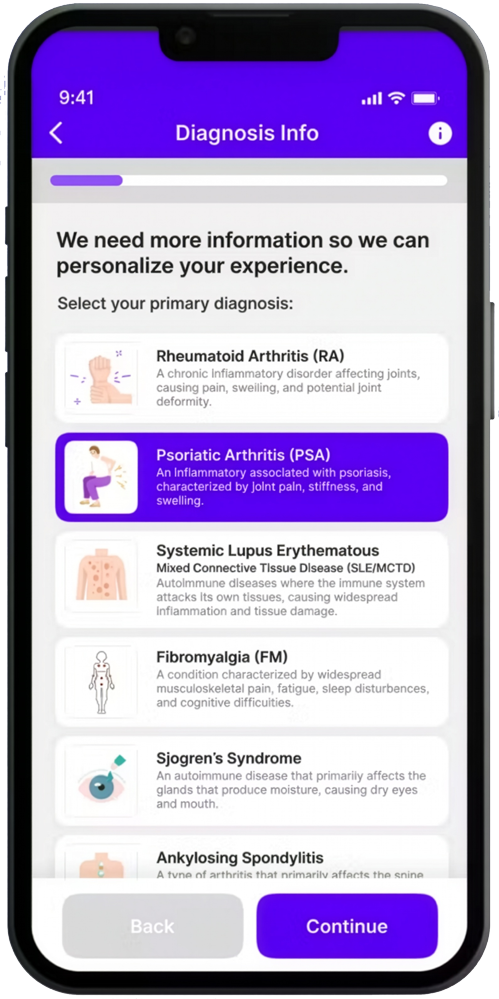
Rheumatoid Arthritis (RA)Psoriatic Arthritis (PsA)Systemic Lupus Erythematosus (SLE)Fibromyalgia (FM)Sjögren’s SyndromeAnkylosing Spondylitis (AS)
Rheumera mobile app screen showing the Diagnosis Info step with Psoriatic Arthritis selected.
Diagnosis-specific onboarding enables selection of a primary condition and tailors the PRO protocol accordingly.

Diagnosis-Specific Protocols & PRO Campaigns

Built for provider efficiency and RTM performance; patients benefit from simple, high-value check-ins and coaching.

Ankylosing Spondylitis icon

Ankylosing Spondylitis

Protocol available

Practice pain: Flares and stiffness drift between visits; limited time to trend BASDAI-like signals.

Rheumera RTM: Automated mobility, pain, and function PROs + escalation when thresholds are crossed.

Patients: Stretch routines, posture tips, and adherence nudges reduce flare days.

Fibromyalgia icon

Fibromyalgia

Protocol available

Practice pain: High message volume and symptom variability; hard to triage what needs action.

Rheumera RTM: Daily/weekly symptom, sleep, and impact trackers summarize to a single signal with flags.

Patients: Micro-education and pacing guidance to stabilize routines.

Gout icon

Gout

Protocol available

Practice pain: Poor urate-lowering adherence; flares missed until acute care.

Rheumera RTM: Adherence check-ins + flare capture produce RTM time and targeted outreach lists.

Patients: Diet/trigger tips and simple “what to do at first twinge” flows.

Polymyalgia Rheumatica / Giant Cell Arteritis icon

Polymyalgia Rheumatica / Giant Cell Arteritis

Protocol available

Practice pain: Steroid taper monitoring and GCA red-flag screening strain staff time.

Rheumera RTM: Taper side-effect checks + vision/temporal symptoms with immediate escalation.

Patients: Clear instructions for urgent symptoms and taper self-management.

Sjögren’s Syndrome icon

Sjögren’s Syndrome

Protocol available

Practice pain: Multi-symptom burden; hard to separate noise from signals requiring change.

Rheumera RTM: Dryness, fatigue, and pain PROs summarized; nudges for adherence and AE capture.

Patients: Lubrication habits, hydration, and fatigue pacing tips.

Systemic Lupus Erythematosus icon

Systemic Lupus Erythematosus

Protocol available

Practice pain: Flares are episodic; visit notes miss in-between variation.

Rheumera RTM: Flare-risk check-ins and med adherence summaries feed RTM documentation.

Patients: Sun/illness precautions and symptom journaling improve self-report accuracy.

Idiopathic Inflammatory Myopathies icon

Idiopathic Inflammatory Myopathies

Protocol available

Practice pain: Functional change between labs is under-captured.

Rheumera RTM: Strength/ADL PROs trend function and alert on decline.

Patients: Home-exercise reminders and energy conservation basics.

Psoriatic Arthritis icon

Psoriatic Arthritis

Protocol available

Practice pain: Skin-joint interplay complicates decisions; biologic adherence gaps.

Rheumera RTM: Joint pain, skin activity, and function PRO bundle with adherence logging.

Patients: Flare triggers and injection coaching increase persistence.

Systemic Sclerosis icon

Systemic Sclerosis

Protocol available

Practice pain: Raynaud’s/ischemia symptoms need fast triage; visits can’t catch changes.

Rheumera RTM: Digital ischemia and skin-tightness prompts with high-priority alerts.

Patients: Warming/vascular self-care guidance and when to escalate.

Undifferentiated / Mixed Connective Tissue Disease icon

Undifferentiated / Mixed Connective Tissue Disease

Protocol available

Practice pain: Diagnostic uncertainty leads to repeat history taking and scattered data.

Rheumera RTM: Longitudinal PRO timeline clarifies patterns and supports decisions.

Patients: Plain-language education reduces anxiety and improves reporting.

Working / Undetermined Diagnosis icon

Working / Undetermined Diagnosis

Protocol available

Practice pain: Backlog at intake; hard to prioritize who needs sooner slots.

Rheumera RTM: Pre-visit campaigns gather structured symptoms to triage scheduling.

Patients: Sets expectations and shortens time-to-plan.

Osteoarthritis icon

Osteoarthritis

Protocol available

Practice pain: Pain/function drift and PT adherence are opaque between visits.

Rheumera RTM: Activity + pain PRO trends, with adherence prompts and plateau alerts.

Patients: Daily steps and joint-friendly activity coaching.

Rheumatoid Arthritis icon

Rheumatoid Arthritis

Protocol available

Practice pain: Treat-to-target needs frequent measures; clinic time is limited.

Rheumera RTM: RAPID3-style PRO cadence with auto-flags and RTM time logs (98975–98981).

Patients: Short, consistent check-ins make disease control visible.

Osteoporosis icon

Osteoporosis

Protocol available

Practice pain: Poor persistence on therapy; fall-risk not routinely captured.

Rheumera RTM: Med persistence checks + fall-risk PRO and intervention reminders.

Patients: Bone-health education and side-effect guidance.

Relapsing Polychondritis icon

Relapsing Polychondritis

Protocol available

Practice pain: Rare disease; flare recognition depends on patient messaging.

Rheumera RTM: Targeted symptom prompts with clear escalation pathways.

Patients: What-to-watch guidance improves timely outreach.

Protocols produce structured notes and time logs to support CPT 98975–98981. Runs alongside your EHR with clear handoffs—no heavy integration required.

Patient Data is Locked

Conventional Episodic Data

Rheumera is the Key

Unrealized Real-world Data
Turn unrealized data into actionable insight with Rheumera.
Integrated Data
With Rheumera unrealized data turns into actionable insight!

Panel Management and Treat-to-Target Strategies

View patient progress with dynamic longitudinal trends. Identify & measure patients against ACR guidelines.

Panel-level visibility
Surface rising RAPID3 and symptom drift across your panel to prioritize outreach and visit cadence.
Treat-to-target support
Track targets over time with background bands and event overlay, making step-up/step-down decisions clearer.
RTM documentation out-of-the-box
Automated check-ins, event capture, and time logs support CPT 98975–98981 with minimal staff lift.

Patients love to share…

We make it easy to review and respond.

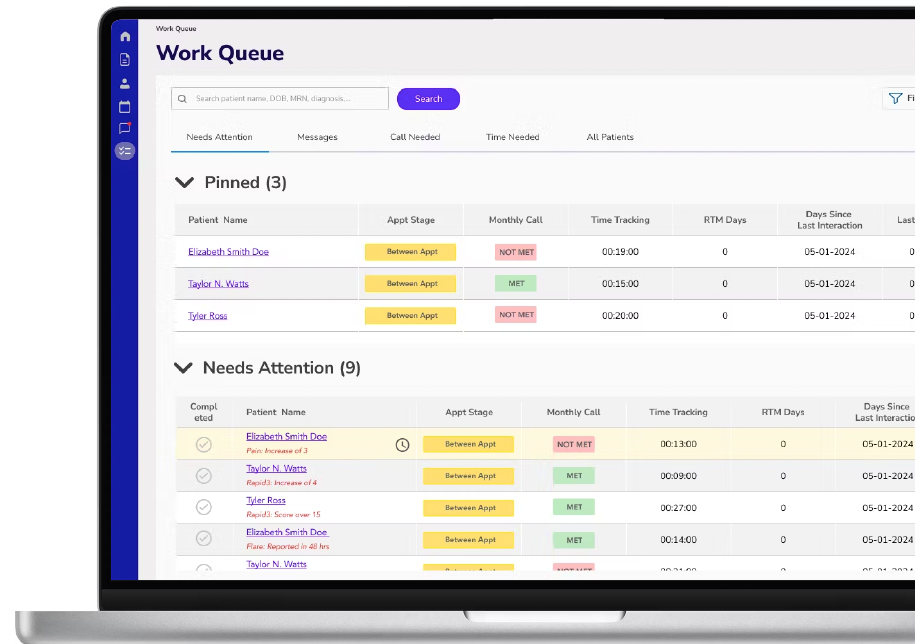
AI that reads everything so you can prioritize your time where it matters — the patients who need support.

Easily identify and respond to patients

  • Smart Work Queue: auto-pin escalating cases and surface “needs attention” based on PRO trends, symptoms, and messages.
  • AI summaries & suggestions: concise context with suggested replies and next steps you can approve in seconds.
  • RTM-ready documentation: time logs, structured notes, and activity capture to support CPT 98975–98981.
  • Lower staff burden: cut noise, reduce message back-and-forth, and focus on patients who truly need outreach.
Rheumera Work Queue: pinned patients and needs-attention queue

Comprehensive RTM Solutions

Everything you need to implement successful Remote Therapeutic Monitoring in your rheumatology practice.

PRO Collection Platform

Automated patient-reported outcome measures with validated assessment tools including, and custom questionnaires.

  • Standardized assessments
  • Trend analysis
  • Clinical decision support

RTM Billing Integration

Complete billing support for CPT codes 98975-98981 with automated documentation and compliance tracking.

  • Automated billing
  • Documentation support
  • Compliance tracking

HIPAA Compliant Security

Enterprise-grade security with end-to-end encryption, secure data storage, and comprehensive audit trails.

  • End-to-end encryption
  • Secure cloud storage
  • Audit trail logging
73%
6 Month Patient Retention
Patient app usage
4 Million+
PROs collected YTD
Through remote monitoring
85%
Medication Adherence
Improvement rate
24/7
Monitoring Coverage
Continuous care

RTM (Proposed 2026)

Remote Therapeutic Monitoring in the 2026 Proposed Rule

The CY-2026 PFS proposes shorter MSK RTM device windows (2–15 days) and a 10–19 minute monthly management tier. Final policies may differ; verify payer requirements before billing.

What’s changing (proposed)

  • New MSK RTM codes: device supply for 2–15 days in a 30-day period (98XX5) and 10–19 minutes of treatment management (98XX7).
  • Right-sized monitoring: expands flexibility for clinically appropriate, shorter durations alongside existing 16–30 day pathways.
  • Payment backdrop: 2026 includes distinct conversion factor contexts; confirm local rates and final policy language when posted.

Note: The “X” in proposed CPTs is a placeholder; AMA will issue the final 5-digit codes. Always verify with your MAC and payers before use.

RTM billing quick reference

Time windows and contact requirements follow CPT guidance; confirm payer specifics.

CodeStatusDescriptorHow Rheumera helps
98975Current
RTM set-up & patient education
One-time at enrollment.
  • Guided onboarding scripts & education modules
  • Consent + eligibility checks logged
  • Device/app pairing checklist with completion proof
98977Current
RTM device (MSK) — 16–30 days
Device supply/access over 30-day period.
  • Automatic day-count for 16–30 window
  • Device activity validation & overlap guards
  • Audit trail for start/stop and clinical rationale
98XX5Proposed
RTM device (MSK) — 2–15 days
Shorter monitoring window; device supply for 2–15 days.
If finalized, starts Jan 1, 2026.
  • 2–15 day counter with payer rule guardrails
  • Prompts to extend to 16–30 when appropriate
  • Alerts to avoid premature/duplicate billing
98980Current
RTM treatment mgmt — 20–39 min/mo
Requires ≥1 real-time interactive communication.
  • Time tracker with team attribution
  • Logs phone/video/chat as interactive contact
  • Auto-generated notes mapped to CPT elements
98981Current
RTM treatment mgmt — each add’l 20 min
Add-on to 98980 in same month.
  • Threshold alerts when next 20 minutes reached
  • Enforces add-on linkage to 98980
  • Prevents standalone misuse of 98981
98XX7Proposed
RTM treatment mgmt — 10–19 min/mo
New lower tier; still requires real-time communication.
If finalized, starts Jan 1, 2026.
  • Low-tier 10–19 minute capture with guardrails
  • Ensures ≥1 interactive contact is documented
  • Prompts toward 20–39 tier when clinically indicated
Explore details in our RTM guide and talk with our team about payer-specific policies.

Plan your RTM program for 2026

Educational content only — not billing or legal advice. Verify with AMA CPT, CMS final rule, and payers.

Talk to our team

Imagine a world where you are the copilot to your care plan...

Start charting your own course of care, reach out to learn more about how you and your provider can get started using Rheumera.

Download on the App StoreGet it on Google Play

If you are experiencing a medical emergency and need help please call 911 or go to the nearest emergency room.